
Fred Hoch - Founder & General Partner TechNexus Venture Collaborative
Fred Hoch on Chicago, Corporate Innovation, AI, Quantum, and the Power of Connecting the Right People
Fred Hoch has spent two decades helping shape Chicago’s technology and innovation ecosystem—and he describes one of his most valuable skills simply: remembering people and connecting the dots.
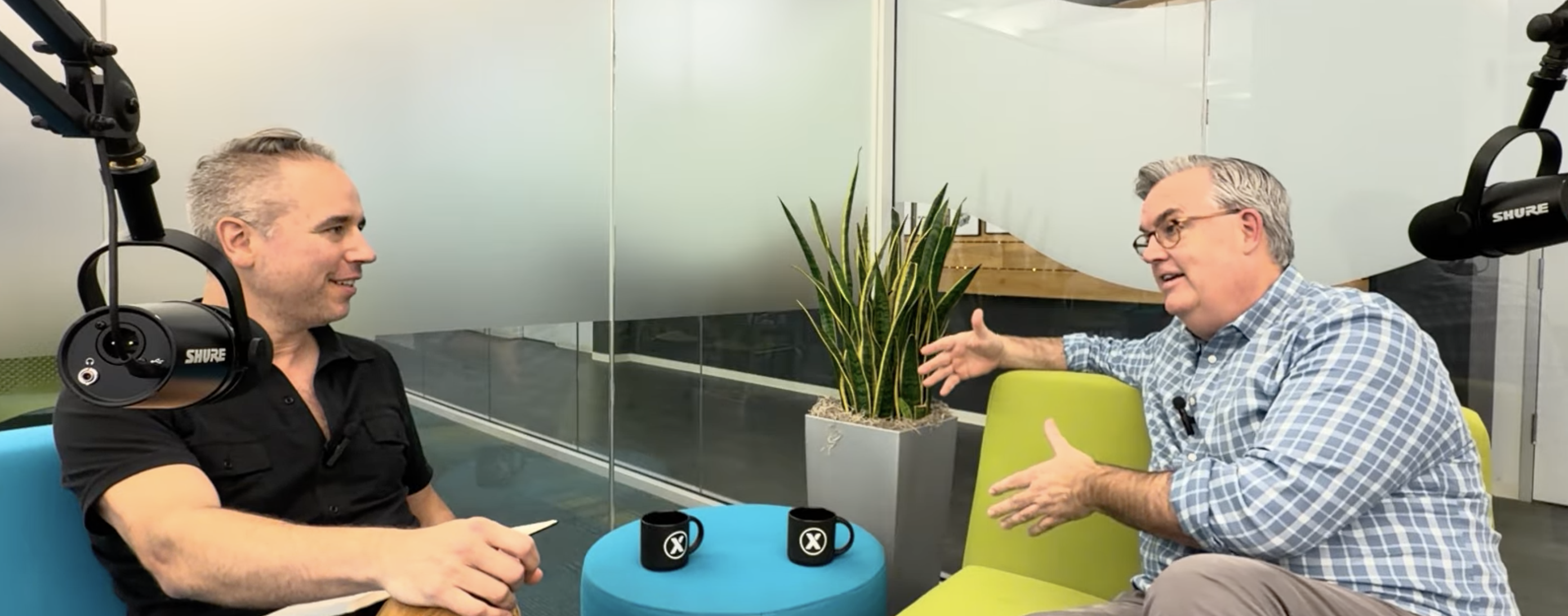
In this episode of Ted Listens, Ted Novak sits down with Fred, co-founder of TechNexus Venture Collaborative, to talk about why Chicago shouldn’t try to become Silicon Valley, how corporations can work with startups to build new products and businesses, and why the Midwest’s diverse industrial base creates a different kind of innovation advantage.
Fred explains TechNexus’s approach to “venture-enabled innovation,” including how corporations can treat startups as opportunities rather than threats, use outside ventures as a form of external R&D, and build relationships with entrepreneurs around technologies that may shape their industries.
They also discuss Chicago’s bet on quantum computing, the opportunities Fred sees for AI inside established industries, why a failed $150,000 investment can still be a major strategic win, and what startups misunderstand about selling into large corporations.
Topics include:
- Why Chicago shouldn’t try to be the next Silicon Valley
- Fred’s unusual ability to remember people and connect the right dots
- How TechNexus brings startups and corporations together
- What “venture-enabled innovation” looks like in practice
- Why corporations can learn by investing before building internally
- Chicago’s quantum opportunity and the next wave of AI
- How established companies can create entirely new lines of business
- Why startups need to understand the corporate clock
- How founders should articulate business value—not just cool technology
The conversation closes where it began, with the question Fred has become known for asking people he meets: What can I do to help you?




“I fundamentally believe that the more people talk, the more they make happen.”
Watch Now
Transcript
Transcript
Edited for length and clarity.
Ted Novak:
Fred, thanks for having me here. One thing I’m certain of from the times we’ve crossed paths is that one of the first questions out of your mouth when you meet somebody is, “What can I do to help you?”
Fred Hoch:
It’s meant sincerely. I think that has been the philosophy behind the organizations we’ve created in Chicago over the last 20 years: how do we support, contribute, and collaborate? I’m also genuinely curious. The other question I tend to ask people is, “What’s your story?” I want to know where you’re from, what you did, and what makes you tick.
Ted:
We’re sitting in the space that a lot of people know as TechNexus.
Fred:
Originally it was TechNexus. We built the clubhouse in 2007 because there really wasn’t a place for Chicago’s technology industry to simply hang out—a common watering hole where people could meet. My business partner and I founded what became TechNexus, and over time the TechNexus Venture Collaborative brand grew beyond the space itself. Today the space is TeamWorking.
There’s a word we use here: “propinquity.” It’s basically serendipity brought on by place. I can count a lot of people who met in these halls who probably wouldn’t have met otherwise, and things happened because of those encounters.
Ted:
You’ve been part of Chicago’s technology community for a long time. Years ago you made the argument that Chicago is not Silicon Valley and should stop trying to be. Do you still feel that way?
Fred:
Very much so. I use a basketball analogy. Steph Curry trying to be Michael Jordan would be a disaster. They have different skills and play the game differently. Nobody says Steph Curry should become the next Michael Jordan. He should be the best basketball player he can be with the attributes he has.
The same thing is true for Chicago. If we always try to be the next Silicon Valley, we put ourselves in an inferior position because the comparison is always us versus what Silicon Valley does best.
Silicon Valley is tremendous at broad-based commercial innovation. It is building foundational technologies like AI. Chicago is different. We have an economy spread across a wide range of industries, and some incredibly important technology has come out of those industries here—electronic trading, travel technology, manufacturing, real estate, insurance, logistics.
We have the context, history, processes, and information inside those industries. My argument has always been: let’s focus on where we’re really good. How do we transform industries instead of trying to copy somebody else?
Ted:
You also seem to have built a career around connecting people.
Fred:
I don’t have a lot of skills. One skill I have is this weird ability to remember things and connect dots. We’ll have a conversation today, I won’t talk to you for two months, and then somebody else will walk in the door and I’ll think, “Those two have to talk to each other.”
I’ve always tried to do that in Chicago. It’s part of “How can I help?” and “How do I find those connections?” I fundamentally believe that the more people talk, the more they make happen.
Ted:
How did that turn into the work TechNexus does today with startups and corporations?
Fred:
Local corporations started showing up and saying, essentially, “We need innovation. We need access to entrepreneurs. We need some of that energy and cultural shift, but we also need technologies that can help us build new products and services.”
At first we did the typical things—demo days, entrepreneur days, introductions. People would come together, everybody would think it was interesting, and then nothing would happen.
We spent about a year trying to figure out a methodology that could create a more effective relationship between corporations and ventures. That became what we call venture-enabled innovation.
The idea is simple: corporations need a way to look at ventures as an opportunity, not a threat. They need a way to work with entrepreneurs without getting bogged down in all the normal corporate processes. And startups need to understand that corporations operate with a completely different clock, vocabulary, and set of incentives.
Ted:
So the investment isn’t necessarily the end goal.
Fred:
Exactly. The investment is the first step. Then the question becomes: how do we make the relationship fruitful for both sides?
Sometimes that leads to technology transfer. Sometimes it gives the corporation insight from a whole group of entrepreneurs. For a typical corporation we might do a dozen investments a year. Over several years that creates an ecosystem of ventures around the corporation.
In the ideal situation, that ecosystem becomes an army of the future. We’re not focused on fixing an internal CRM system. We’re asking how these companies can help create the next products, services, and markets the corporation needs.
One example is work in the marine industry. When we began, electric propulsion and autonomy were still areas established companies were debating. By investing around those themes and working with entrepreneurs in the space, corporations could learn faster and bring new technologies into the market. Today you see boats with autonomy, sophisticated digital interfaces, electric systems, and entirely new adjacent products.
Ted:
How do you actually find the startups?
Fred:
We start with the corporation. If you talk to all the business heads and the C-suite, you may get 10 or 15 ideas about what the company should be thinking about for the future. We narrow that down to four or five themes.
Then we source companies around those themes globally. It’s not just whoever happens to walk through our door. We use the networks we’ve built through corporations, universities, entrepreneurs, associations, and ecosystems all over the world.
A relevant battery technology might come out of Knoxville, Tennessee—somewhere you would never think to look if you were only watching Silicon Valley. Our investments span dozens of U.S. cities and multiple countries. Only a small percentage are actually in Chicago. The point is to find the right technology for the corporation’s strategic themes, wherever it happens to be.
Ted:
Chicago is making a very visible bet right now on quantum computing. How do you look at that?
Fred:
I think we had an opportunity and decided to make a big bet. What’s happening on the South Side is really interesting. Quantum isn’t ready for prime time yet, but it is a technology that could be transformative.
The important part for Chicago is that the real value of technologies like quantum and AI ultimately comes from applying them to actual industries. Chicago and the Midwest are full of the corporations and industries that can benefit from those technologies.
Will Chicago win the quantum race? Who knows. There are huge companies and countries working on it. But we made a bet, and at least we’re in the race. Chicago historically hasn’t always been willing to make bets that big.
Ted:
AI is obviously much closer to the market. Where do you think the real opportunity is?
Fred:
A lot of the conversation right now is around the large language models themselves. Those models create a base layer, but the really interesting value comes when you combine them with the knowledge, data, processes, and context of a specific industry.
If you’re a manufacturer, the model by itself isn’t the advantage. The advantage is everything your company has learned and built over decades, combined with the new technology. That’s where you can create enormous value.
That is another reason I’m bullish on Chicago. We have all these different industries sitting next to each other. An AI company working with insurance can potentially learn something from financial technology. A manufacturing application can draw from logistics. There are opportunities to combine knowledge across industries that aren’t direct competitors.
Ted:
What do you think we’ll look back on 20 years from now and realize we misunderstood about AI?
Fred:
I think we’ll realize we were too focused on destruction. Right now we talk about AI pictures, writing emails, job losses—all of those things are real, but they aren’t scratching the surface of where this goes.
I think it becomes an economy-creation story. Pieces of the economy will shift. Jobs will change. But the technology will also make people more productive and create things we can’t see yet.
Ted:
Are big corporations already thinking that way?
Fred:
We’re barely scratching the surface. There are corporations that have spent months negotiating an enterprise AI agreement while telling employees they can’t use the technology internally until the agreement is finished—which, of course, often means people are finding ways to use it anyway.
Most corporations are still thinking about AI as an enabling tool for day-to-day operations. They haven’t really reached the larger strategic question: what products, services, or businesses could we build because this technology now exists?
Ted:
That sounds like a broader theme in the way you think about innovation—not just making the existing product better, but asking what else the company can become.
Fred:
The smartest corporations are thinking about themselves not only as what they’ve always been, but as what they can extend into.
If you’re an industrial manufacturer, maybe there’s a parts business, a rental business, a membership business, or some other adjacent revenue stream. Software companies have been doing this forever. They start with one product and expand into a suite. Industrial companies can do the same thing, but it’s harder because it isn’t necessarily in their DNA.
They do have the resources, expertise, and knowledge. They just have to be willing to go down a different path.
Ted:
What stops them?
Fred:
A common mistake is putting one person in the corner and saying, “Congratulations, you’re the innovation person.” That person is still beholden to the corporation. Their compensation is tied to the existing metrics. They’re stuck in the same process they’re supposed to disrupt.
Corporations also have quarterly numbers to hit. You have to find a way to explore new ideas without disrupting the core business. But if you don’t do it, someone else eventually will. Companies have to find ways to access external innovation and create new revenue, not rely entirely on what they can invent inside their own walls.
Ted:
You told a story that makes that point especially well—the failed investment.
Fred:
One corporation made one of its first investments with us—about $150,000. After roughly a year, the startup failed. We were worried because this was one of the first real losses in the program.
When the CEO heard what happened, his response was basically, “Great.” His point was that the $150,000 loss had saved the company roughly a million dollars it might have spent internally trying to figure out the exact same answer.
That’s a different way to think about failure. They learned something faster and cheaper. Then the CEO’s question was: “What’s the next one?”
Ted:
You and your business partner have also worked together for more than two decades. What makes that work?
Fred:
We have different skills. There are times when one of us is more focused on the big vision and the other is focused on how to get there. Those roles can switch depending on what we’re building.
The foundation is trust. If I had to give advice to anyone in a business partnership, it would be to build trust and have honest communication. If you’re holding back resentment or not getting what you want from the relationship, you have to say it.
Ted:
Let’s end with advice for the two groups on either side of the work you do. First, what would you tell a corporation that wants to work with startups more effectively?
Fred:
Recognize that entrepreneurship and ventures require a different mindset from the corporation. You need to find a way to work with them without forcing them into your existing box.
That could mean investing, partnering, building something together—whatever the model is. The important thing is to see the venture as an opportunity rather than a threat and to recognize that it knows something different than you do.
Ted:
And what would you tell the startup?
Fred:
First: it’s going to take longer than you think. A startup has one good meeting with a major corporation and thinks, “They’re going to buy from us tomorrow.” The corporate clock may just be starting. Six months can go by before anything meaningful happens.
Second: you’re enamored with your technology. I understand—you built it and you think it’s the greatest widget ever made. But the corporation needs to understand the value of that technology to what it does today or what it could build tomorrow.
Show them how it affects product development, revenue, speed, cost, or a new opportunity. Don’t just tell them the robot is cool. Explain how the robot helps them produce something faster, smarter, or better—or creates an opportunity they didn’t have before.
And don’t make one corporate opportunity your entire company. You need focus, but you also need enough optionality that one long sales cycle doesn’t determine whether the business survives.
Ted:
Fred, I really appreciate the time. I knew you were busy before we sat down, and I think this meeting somehow got more expensive the more you talked.
Fred:
Thanks for having me. And of course—what can I do for you?


.png)


