
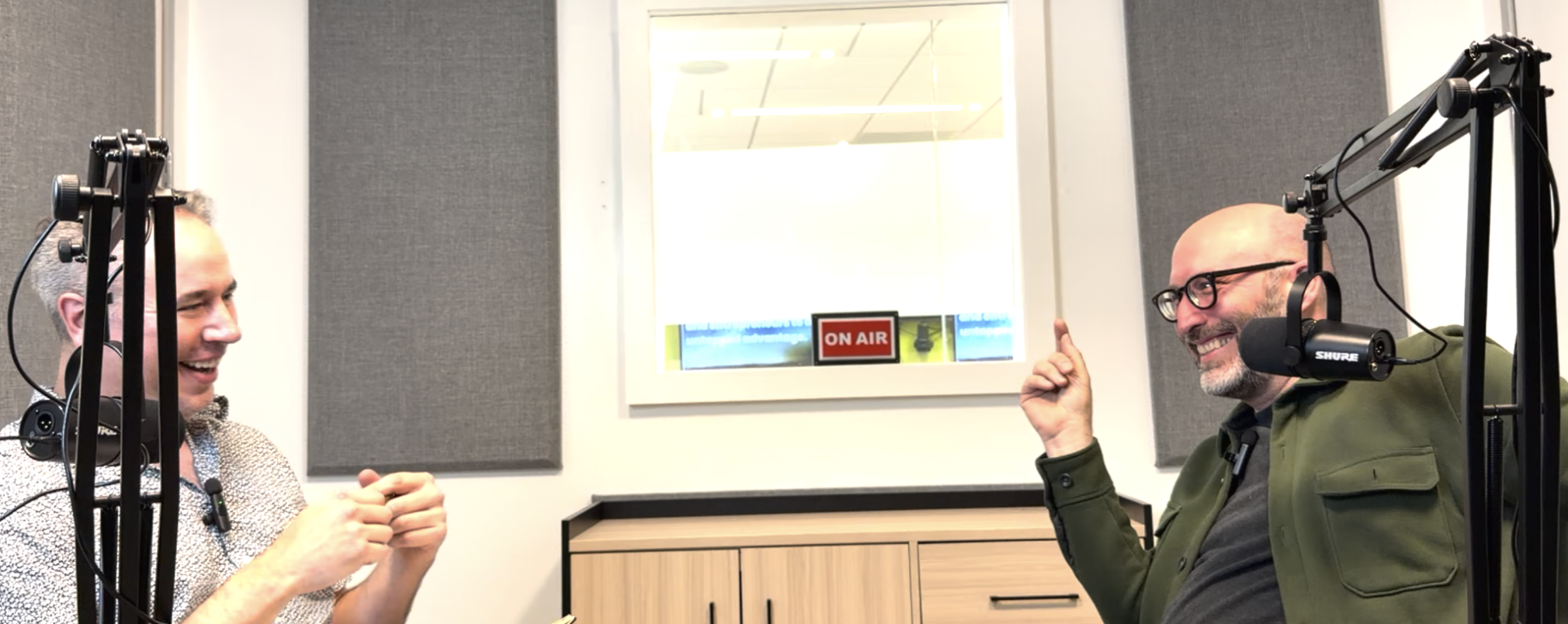
Justin Kaufmann on Chicago, Journalism, AI, and Why Authentic Voices Still Matter
What makes great journalism feel human?
In this episode, Ted sits down with Justin Kaufmann to explore the evolution of Chicago media, his journey from internship through the last 25 years covering Chicago, the future of AI in journalism, and why Chicago remains one of the greatest storytelling cities in the world.
Justin’s career spans more than two decades in Chicago media, including roles at WBEZ, WGN Radio, and now Axios, where he helped launch Axios Chicago alongside veteran journalist Monica Eng.
The conversation begins with stories from Justin’s early internship days, cutting reel-to-reel tape, serving food at live events, and learning firsthand that showing up and doing the work creates opportunity.
From there, the discussion expands into the changing landscape of journalism:
- Why Smart Brevity resonates with modern audiences
- How local journalism can still feel personal and authentic
- The tension between AI efficiency and human storytelling
- Why personality-driven media continues to win
- The role Chicago culture plays in Axios Chicago’s voice and success


“The personality is the product.”
Watch Now
Transcript
Ted Novak:
Justin, thanks for joining me on the show.
Justin Kaufmann:
Ted, thank you.
Ted Novak:
One of the things I realized before having you on was I had just responded to a junior in high school asking for an internship.
Then I got your email saying you’d love to come on the show and I’m thinking, “I’m kind of the junior in high school here.”
You’ve spent 25 years covering Chicago and telling stories.
Justin Kaufmann:
I’ll always say yes to talking about Chicago.
I think podcasts are a great way to talk about the city.
Justin Kaufmann:
I was probably a freshman in college when I applied for an internship at WBEZ.
I didn’t get a response.
So I became a teaching assistant at Columbia College for a radio production class.
The instructor was the general manager of WBEZ.
Eventually I asked him about internships.
A week later I got called in.
The interviewer walked in late and asked me one question:
“Can you cut tape?”
This was reel-to-reel tape back then.
I said yes.
He said:
“You’re hired.”
Justin Kaufmann:
One of the biggest moments in my career happened during an internship event at WTTW.
I was supposed to help with production.
Instead, they handed me a hairnet and told me to help the kitchen staff serve food.
I remember thinking:
“This isn’t what I signed up for.”
I almost walked out.
But I stayed.
I served mashed potatoes and mac and cheese all night.
The next day my boss called me in and said:
“You didn’t walk.”
And because of that, they offered me my first paid job in journalism.
Justin Kaufmann:
I worked at WBEZ from 1994 until about 2015.
Then I moved to WGN Radio and hosted my own show.
Eventually during COVID my contract ended.
At the same time podcasting and remote broadcasting technology exploded.
A former colleague asked me to help produce Axios Today.
That’s how I got introduced to Axios.
At the time they only had a few local newsletters and didn’t think Chicago would work because they thought the market was too competitive.
I argued:
“Chicago is a world-class city with a small-town feel.”
Eventually Monica Eng and I pitched ourselves together and launched Axios Chicago.
Ted Novak:
I’d love to talk about Smart Brevity.
Justin Kaufmann:
Efficiency is key.
Traditional journalism taught us to provide all the context and backstory first.
Axios looked at that and said:
“What if we remove all the fat?”
We use things like:
- Why it matters
- Zoom in
- Zoom out
- Bottom line
People think writing short is easier.
It’s not.
“Smart Brevity isn’t easy to do.”
Ted Novak:
One thing I appreciate about Axios Chicago is that it feels different than traditional media.
Justin Kaufmann:
Most legacy media companies use newsletters as marketing platforms.
They only link to their own reporting.
We decided:
“We’re not going to do that. We’re going to try and share everybody’s stories.”
That builds trust with readers.
Ted Novak:
AI has obviously become a huge topic in media.
Justin Kaufmann:
Absolutely.
Back when I started, if you recorded an hour interview you spent another hour transcribing it manually.
Now tools like Otter and Descript can do that instantly.
That changes the game.
But I think there’s danger when companies try replacing the human voice.
“I think the audience can tell when there’s no human in the loop.”
Ted Novak:
Yeah.
Justin Kaufmann:
People are drawn to personality.
That’s what they connect with.
That’s why personality-driven media still matters.
Justin Kaufmann:
The Axios Chicago newsletter is really:
“A talk show in an email format.”
You’re not just getting hard news.
You might get a Kaufman Quiz.
You might get nostalgia.
You might get sports.
You might get politics.
That’s intentional.
Justin Kaufmann:
I consider myself:
“A subject matter expert on Chicago.”
Not just politics or sports or media.
Chicago.
That means understanding neighborhoods, people, culture, business, transit, sports — all of it.
And I still learn new things every day.
“I really truly love that every day you learn something new about the city.”
Justin Kaufmann:
I take journalism seriously.
I love telling the stories of Chicago.
For me:
“It’s a job. It’s a calling. It’s a hobby. It’s all of it wrapped into one.”


.png)


